Greetings! Have you ever wondered if a movie's worth blowing the money on to see at the theater or what to add next to your NetFlix queue? Then you've come to the right place! Enjoy!
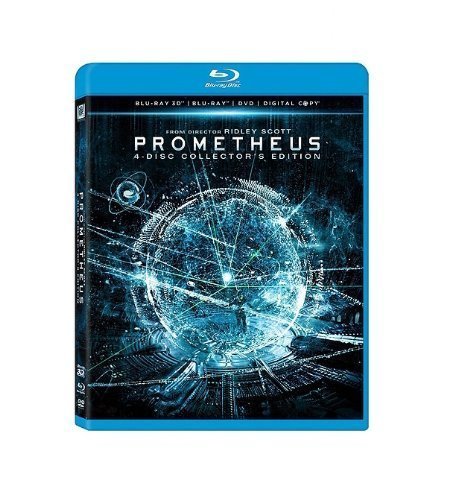
In preparation for the upcoming Alien: Covenant, we watched Prometheus again because while I'd been watching the Blu-ray in bits and pieces as a test disc for home theater tweaking - I hadn't really watched watched it despite getting the deluxe 3D version upon its release (more on this in a moment) - the missus hadn't seen it since we'd seen it in the theater five years ago. I don't know why I haven't written up a review of this package before and there's a problem with it you'll see it a bit, but I must note have screened the full movie thus the lack of an entry here.
While people still treat Prometheus as some sort of cinematic war crime, on second appraisal it's not that bad and I'd bump the film score up to a 7/10. The dumb stuff is still dumb and Holloway is a complete tool and thus his death isn't really that much of a loss (spoiler alert!), but the overall slick style, Fassbender's performance and Ridley Scott's ability to still throw down a tense scene like the auto-doc alien extraction sequence make it a missed opportunity more than a complete failure.
More problematic is this Blu-ray release which along with Life of Pi saw Fox putting some of the special features exclusively on the 3D version release, forcing people to either buy a version they may not even have the capability or interest in watching in order to get all the extras or doing without. While Life of Pi's omitted extras appear to be minor, the 4-disc collector's edition I bought (and sold off the 3D disc to a friend) came with an amazing disc of extras with a production documentary and tons of goodies which were actually better than the movie itself. The problem is that it appears to have gone out of print - it lists on Amazon for over $350(!!!) and while Best Buy lists it for $20, it's not actually available.
If you're not an extras fiend like me, then the basic disc is a good pickup for $10 or less; the transfer and audio are pristine and the movie doesn't totally blow despite being full of bonehead actions which led to Cinema Sins coining the "Prometheus School For Running Away From Things" to describe any time people aren't trying to dodge to the side.
Score: Collector's Edition - 8.5/10. Buy it if you can find it. Regular Edition - 7/10. Buy it cheap.
Watched it again on Vudu with the girlfriend in prep for seeing the sequel with her. She slept through most of it because she's seen it before. Sigh. Hope she remembers enough to understand what's happening.
In the late-20th Century an attempt was made to reboot the moribund Superman franchise with Superman Lives, a Jon Peter-produced movie with Tim Burton directing, Nicholas Cage starring and Kevin Smith writing the first draft. With tens of millions expended on pre-production and pay-or-play deals, the production was shut down three weeks before it was to start shooting.
As bizarre-looking costume test photos leaked out showing a stoned-looking Cage in a shiny blue rubber suit leaked out - Superman Lives director Bryan Singer would keep that photo handy to shut up anyone who questioned what he was doing with his film - and Kevin Smith's recounting of his involvement with the project (Parts One and Two here) became legend, the true story of what killed Superman Lives was mostly speculation and conjecture until now as writer-director Jonathan Schnepp has pulled together the threads and woven The Death of 'Superman Lives': What Happened?
Stunningly getting the participation of every main and secondary participant but Cage (who appears in fitting videos), Schnepp interviews Peters, Burton, Smith and the two screenwriters who followed him, costume designer Colleen Atwood, and the army of illustrators, designers and artists, showcasing an overwhelming amount of illustrations and test models. Everyone seems candid and honest, though Peters flat out denies Smith's claim that he asked that Superman not fly or wear the costume.
While the copious artwork and deep-diving will probably satisfy uber-nerdy Superman fans, it drags out the feel of the 104-minute documentary making it less suited to more general audiences. It's fascinating to see the ideas being pitched around like the Kryptonian Skull Ship which is exactly as it sounds, but struck me as possibly being too goofy-looking for a live-action movie.
Ultimately, Warner Bros.' string of box office bombs ultimately killed the project (ironically, the money went to fund another bomb), but for those who've always wondered what could've been, for better or worse, The Death of 'Superman Lives': What Happened? definitely sets the record as straight as could be hoped. A must-watch for superhero movie fans; slightly less so for general audiences.
Score: 6/10. Catch it on cable. (It's currently on Showtime.)
When the first trailer for Colossal dropped, the premise was a grabber: A young woman (Yummy Girl, known to you people as Anne Hathaway) discovers that she is somehow responsible for a giant kaiju monster stomping on Seoul, South Korea. Hijinks ensue. What's not to like about that? Sounds like fun, right? What the trailers don't reveal and most reviews have hidden - though the first one I read explicitly blew the back half in order to allow for SJW axe-grinding - is that the fun rapidly drains out in service of some ugly turns which aren't earned. If you're concerned about spoilers, jump to the score and come back later.
After an odd prologue showing the monster appearing in Seoul 25 years ago (which is eventually explained), we meet Yummy Girl as she wanders into her Manhattan apartment after another night out partying, babbling rote excuses about how her being gone all night isn't her fault to her clearly steamed boyfriend. Fed up with never seeing her unless she's hungover and carrying her after being unemployed for a year, he's kicking her out.
With nowhere to go, she returns to her unspecified Middle-American childhood small town to move into her parents' empty home. While lugging home a heavy sack, she encounters Jason Sudeikis, a childhood schoolmate. Giving her a ride they end up at his bar, which he inherited from his father, and she immediately falls in with Sudeikis' drinking biddies (Tim Blake Nelson and Austin Stowell), hanging out boozing until dawn, leaving and walking home with her bundle. Waking up in the afternoon, she learns that a monster has appeared in Seoul.
After a repeat appearance the next night, she immediately realizes her connection to it and somehow figures out that it happens when she crosses a playground. She reveals this to her new friends and attempts to make amends to the people their by writing an apology in the sand, but then its revealed that when Sudeikis enters the playground a giant robot appears in Seoul, doubling the terror for them and the complications back here.
This is where Colossal takes the turn that the ads and reviews hide. Sudeikis' nice guy character - he give her a TV and furniture for her house - veers into Evil Controlling Sociopath territory as he becomes jealous of her hots for the hunky, shy Stowell. (Why she's after him isn't really spelled out. He's a bland, handsome blank.) When her ex from NYC comes to town, ostensibly for a coincidental business meeting, the theme of "evil men consumed by toxic masculinity and need to control and oppress women" really blares forth, culminating in (SPOILER ALERT!) Sudeikis' threat that if she leaves he will go back to the the playground every morning and have his giant robot avatar wreak havoc on the other side of the world. Wotta swell fella.
The problem with this turn of the story is that it's not earned. Yummy wasn't his high school girlfriend, though he obviously has harbored a crush on her and has Googled her up. (Who hasn't looked up an ex or ten online just because?) They had no relationship, so his violent reaction to what she does just comes off as extreme. Sudeikis, who has made a name as the bland sorta straight guy in comedies like Horrible Bosses and We're The Millers, is quite chilling in his dark turn; he's just let down by a poorly-motivated script which really faceplants in their final confrontation despite its obvious attempt at crown-pleasing.
Yummy is also quite good, making her drunken wreck somehow appealing and winsome, though clearly troubled by the mayhem and death she has accidentally caused, at least until the script forgets about all that and goes off on the He-Man Woman-Hating Club stuff.
My girlfriend didn't know about the twist and didn't like it, feeling it should've been a straight-up comedy as advertised, though she agreed that if they'd more properly sold the rationale for Sudeikis' anger and possessiveness towards Yummy, it may've worked better. (Off the top of my head, how about Yummy being a former high school mean girl who was cruel to Sudeikis because his dad "just owned a bar" and he's always wanted to pay her back for her snobby cruelty now that she's the needy one? Not saying this is awesome, but it's better than what's there.)
The march to The Fate of the Furious continues with what is hands-down the best and most well-rounded of the entire series. My original theatrical review still stands. The sound and picture quality are good. Didn't have a chance to look at the extras yet, but they appear respectable.
I originally reviewed this Blu-ray six years ago and dug it out to refresh myself in preparation for this weekend's arrival of the controversial live-action ScarJo version and upon second viewing I'm finding that 1995's anime classic Ghost in the Shell is a tad overhyped. People remember the iconic action sequences or the shocking (robo) nudity or the haunting score, but lost in the reminiscences are the fact that the plot makes little sense and there's way too much philosophy dumping going on.
The opening thermoptic camo scene makes the Major look like an assassin, not a cop. All the nattering about the "ghost" maybe being or not being the human soul is half-baked and the political chicanery and investigative work to detect possibly illegally cloaked people who then never are revealed is just confusing.
The biggest stink over the casting of ScarJo is that it fed the SJW outrage pimps another example of "whitewashing" (in which evil disgusting white actors are playing roles believed the sole property of "People of Color"), but as with so much anime, there is nothing Asian about Major Motoko Kusinagi other than her super Japanese name and since her body is robotic and her appearance manufactured, what makes her "Asian" to the point it requires racially-specific casting? (FWIW, I would've gone with Rinko Kikuchi from Pacific Rim.)
While the original Ghost in the Shell remains something self-respecting cinephiles should see, it will be interesting to see how this live-action version, which reportedly takes elements from both theatrical films and the Stand Alone Complex series and blends the philosophical angles with the need for sci-fi shooty-shoot action.
When I saw the trailer (below) for The Assignment I wondered what the heck it was supposed to be. Within five minutes, I could tell it was going to be some Biblical level of suckage, but perverse curiosity as to why this cast was involved in this mess kept be going. Ugh. The things I do for my readers.
As the trailer lays out, M.Rod plays a hitMAN who was given an involuntary sex change as revenge for killing Sigourney Weaver's brother. What's not shown is the framing device for this tale - Tony Shaloub's psychiatrist character conducting an evaluation on Weaver's doctor which opens with them spewing some of the worst Basil Exposition dialog ever committed to digital video (can't say film anymore, right?) and immediately making one wonder if the all shared the same agent who lost a bet and had to force his clients into this weird mess?
As it trudges through it's allegedly shocking tale of revenge - since half of it is told in present day narrating flashbacks, there's never a doubt as to who survives - it never rises above it's thin premise. But the actors commit to the dreck fully, though I couldn't stop wondering why they accepted the gig. Yes, co-writer and director Walter Hill produced Weaver's Alien movies and had some notable flicks 35-40 years ago(!), but I don't get it and pondering that helped get through this.
There's a minor reveal at the end, but things hinted at meaning something like Weaver's wearing of men's suits never pay off. The only thing The Assignment will be remembered for is that Michelle Rodriguez made her nude debut after 17 years in the biz in her late-30s. But you'll be able to find that on the Internet and the context doesn't make it any better.
Score: 2/10. Skip it unless you are a perverse masochist who can't believe it's this bad.
If you're wondering why it's called Tomboy at the end, it's because it was also titled that and (Re)Assignment. When you can't settle on the title....
The most surprising thing about Money Monster is the director: Jodie Foster, making only her fourth feature film in a quarter-century and, omitting 2011's The Beaver (which had its released nuked by star Mel Gibson's image problems despite having good reviews), her first in 21 years. The surprise is compounded by the subject matter and brisk handling its tale requires; nothing she'd done before indicates a taste for such fare.
George Clooney stars as Lee Gate's a Jim Cramer-esque host of a cable TV financial show called Money Monster patterned after Cramer's Mad Money. Schlocky, with sound effects, video clips and even backup dancers, Clooney dishes out stock tips and bromides. However, one hot pick he'd pushed, an outfit called IBIS had experienced what was being called a glitch where its high-frequency trading algorithm supposedly had a problem causing the company's stock to plunge $800 million instantly, severely damaging investors.
One such investor is Kyle (Jack O'Connell), a poor sap who put his meager inheritance into the stock only to be wiped out. Wanting an explanation as to how such a "glitch" could happen, he passes himself off as delivery man and makes his way onto the set where he produces a gun and an explosive vest which he has the hostage Clooney don on live TV.
As the police lock the building down, the show's director Patty (Julia Roberts) tries to track down the MIA CEO of IBIS (Dominic West) in order to appease Kyle. Assisted by IBIS's suspicious communications officer (Caitriona Balfe), the race is on to figure out just how so much money can disappear and no one seems to really care since the ultra-wealthy are still rich and the shlubs like Kyle are invisible to the Masters of the Universe.
Despite some provocative themes - rich vs. poor, connected vs. serfs, rigged vs fair markets - Money Monster doesn't take the path down Occupy Wall Street too far, opting for a swiftly-paced thriller with corporate shenanigans plot on the side. Foster's tempo in the beginning is too brisk as they race onto the set with implausible banter, but once Kyle arrives with his delivery of the plot, things calm down and the pace digs in and the tension ratchets up. When all is revealed, it all seems a bit far-fetched, yet not that unique for a movie. Some valid targets about voyeuristic audiences and how they react to watching life-and-death situations could've had more teeth, but as with the financial games aspects, I don't think they wanted to bite too hard, settling for entertainment over incitement.
Clooney is good enough, though I never really bought his show's shtick. Roberts is good at being tense and drab. O'Connell has a weak hand dealt as a stereotypical lower-class New Yawker and looking at his bio, I see my nagging suspicion as to why he seemed cliched is confirmed: He's another English actor playing an American because we've apparently stopped making actors in NYC. Pffft.
Glossily shot by Matthew Libatique (Iron Man, Straight Outta Compton, The Fountain, Josie and the Pussycats!), Foster's foray into popcorn-level drama is ultimately as insignificant as the DJIA going down 3 points, but there are worse ways to spend an afternoon on the couch watching it.
No, Sully it's a movie about the big blue guy from Monsters, Inc. It's a surprisingly bland and unengaging biopic by Clint Eastwood about Chesley "Sully" Sullenberger, pilot of the "Miracle on the Hudson" flight in January 2009 in which he landed his plane with 155 souls on board on the frigid Hudson River (between Manhattan and New Jersey) with no loss of life after a herd of birds knocked out both engines of his Airbus.
Focusing on the NTSB (National Transportation Safety Board) investigation which is portrayed as a witchhunt seeking to blame Sully for ditching the plane when computer and pilot simulations indicate he couldve made it back to LaGuardia or landed at Teterboro in NJ, Sully jerks around from focusing on his nightmares, sometimes waking, about how it could've crashed in the city, to calling his wife, to coping with strangers going "You're that guy!, to a couple of random flashbacks of his piloting as a youth and in the military, to a recreation of the incident itself (which has some sporadically sub-par CGI VFX).
Events seem randomly tossed out and there is no real narrative coherence as if Eastwood and writer Todd Komarnicki really didn't have a central thesis to hang everything else off of. The series of reveals and turnabouts at the culminating public NTSB hearing are clearly intended to rouse the audience to cheer for our hero against the mean government inquisitors, but it beggars belief that it would've gone down this way. It rings phony.
Tom Hanks is good with the limited material he's been provided, conveying the rock solid stoicism that allowed him to pull off such a piloting feat - sure, it's not as spectacular as the crash sequence from Flight, but that was total make-believe - and subsequent self-doubt as to whether perhaps he had screwed up because those government fellers sure seem pretty certain he did. Aaron Eckhart doesn't have much to do as Sully's co-pilot, but he rocks a bitchin' porn 'stache that makes him look like a baseball pitcher.
While competently made, Sully misses the points I suspect it was trying to make about how heroes are treated in a cynical world or something; it's all too scattershot and lackluster to stick, never gripping, just floating along like a plane on a river.
How many times have we seen a variation of the "creepy stalker dude is obsessed with woman and kidnaps her to make her love him" story? At first blush, it seems that Pet is just another misogynistic torture porn movie until the end of the trailer has an eyebrow-raising moment. But while the trailer for Pet implies one kind of movie and hints at another angle, it manages to not give away its real surprise, which while pretty nifty, is undercut by lackluster and tired execution. They had one bright idea and didn't know how to really handle it.
Dominic Monaghan (Lost, Lord of the Rings) is Seth, a creepy loner who works in an animal shelter. He's obsessed with Holly (Ksenia Solo - Kenzie on Lost Girl; Black Swan), a waitress whom he approaches on the LA bus and then proceeds to pester at her job, following her to the bar, basically creeping her out. As indicated in the trailer, he eventually kidnaps her and puts her in a cage because of course.
While Pet takes its sweet time to set its familiar table, just over halfway through comes the whammy and while I am normally loathe to even spoil that there are twists in movies - it has driven me crazy how movie ads blatantly proclaim there's a twist so you spend the whole time looking for and trying to figure it out before it happens (the upcoming Split by Mr. Movie Twist himself, M. Night Shyalaman is being touted this way) - in this case I'm making an exception because I really didn't see it coming and even if I'd known something was coming, I would never have guessed it.
The problem is that after the twist, it all proceeds pretty predictably. Seth's efforts to hide that he's got a girl caged up in the basement of the shelter under the suspicious eyes of a security guard play out predictably and then there's the issue of Holly's ex-boyfriend or employer never seeming to notice she's been off grid for weeks, especially when Seth's contacts with her were known. No one is looking for her?
Solo is really good as Holly, providing a side of her that wasn't really shown off on Lost Girl. Monaghan is OK, limited by the script by Jeremy Slater. Spanish director Carles Torrens tries to imbue the story with a thin script with some noirish visuals, but mistakes slow pacing for dramatic buildup (a flaw of Denis Villaneuve's films).
If not for the twist and Solo's performance, there's not really much to recommend Pet because it's surrounded by familiar stock elements we've seen too many times before. It's a pity, because there is a bright idea caged up on the medocrity.
Even the most ridiculous movie premises need a kernel of grounding in reality to work and the supposed critique of social media, shallow celebrity and risky thrill videos, Nerve, doesn't seem interested in playing by those rules as it tells its silly story about daring to break the rules for fun, fame and profit.
Emma Roberts is a high school senior on Staten Island with Sandra Bullock's Syndrome (a condition in movies where we're supposed to believe a traditionally attractive woman can't get a guy because reasons). Dithering about whether to go an art school in California and unable to tell the hot jock she's crushing on him, she watches as her bestie, a trashy party girl stereotype, moves on him instead. Upset, she signs up to play Nerve, a game her friend has been playing and gathering followers.
Copypastaing from Wikipedia here, "The game collects her personal data and explains the three rules: all
dares must be recorded on the player's phone, earned money will be
revoked if a player fails or "bails" a dare, and a player must not
report the game to law enforcement. In addition, the top two
most-watched players will compete in a highly sought-after final round." This is Nerve's first credibility shark jump: We see her Facebook profile and other data slurped into the system which eventually is revealed to include total bank account access to deposit and drain money which is the technophobe's vision of what the Internet is like. (Since the target market for this movie is tech-savvy kids, it's as if an Amish person living in the jungles of New Guinea dreamed up this plot.)
Her first dare is to kiss a stranger at a diner for five seconds which brings her in contact with Dave Franco, the Jim Belushi of the Franco family. They quickly team up as it's clear the game is steering both of them into parallel and colliding paths. This is the next BS detail: As dares are issued and payouts remitted, who is ultimately controlling the game. While its open-source nature becomes a plot point, the anonymity of players and viewers (which becomes the lynch pin of the finale) doesn't jibe with the deliberate manipulations going on.
Also floating out there is her bestie, offended that Roberts has blasted past her in followers and ranking, risks her life on a dare and starts macking on the jock to pay her back. Because mean girl, man. If this is the commentary on fame and friendship part of the show, it's too stupid to land a punch.
Of course, it ends up in a scary showdown in a public place where somehow everyone knows to gather without the authorities catching wind. Did I mention that Roberts has a Platonic friendzoned boy pal who is a super nerd and likely to be involved in saving the day with his mad h4x skillz? Yeah, that happens.
While colorfully shot and generally entertaining in a not-hating-myself-for-watching-this way, Nerve doesn't suffer from a lack of that, but a typical lack of brains.
They should've called The Shallows something more descriptive like Girl vs Shark because that's literally what it is, not that it's a bad thing.
Blake Lively is a surfer chick heading for a secret beach in Mexico that her recently-deceased mother visited while pregnant with her. She's debating dropping out of med school because everyone ultimately ends up dying and someone read some Nietzsche. A scene of her talking via FaceTime to her father, Basil Exposition, basically exists to let us know she's a med student because she's a med student and it will sure be good that she's a med student in case she were to, you know, be in need of medical assistance for some reason.
Like being bitten by a gigantic Great White shark. Whoopsie!
Chomped on the thigh and stuck on an exposed finger of rock that's in danger of becoming submerged when the tide comes back in, she's royally screwed because the beach's isolation means there are few others to see she's in need and she's too far out to swim to shore while the shark is in the neighborhood, even if she wasn't leaking blood into the water.
It's a tidy little scenario and it works because Lively's character is resourceful and not a damsel. Did I mention she's a MEDICAL STUDENT which makes her survival plausible. Sure, the premise is goofy, no blonde hottie should be hitting secret Mexican beaches alone (her friend was too hung over to join her) from a basic safety standpoint, and she somehow manages to still look smoking hot at the end of ordeal baking on the rock in the sun without fresh water, but it's still a taut and tense flick. Worth watching.
Score: 7/10. Catch it on cable.
Don't watch this VFX breakdown until after seeing the movie in order to have your mind properly blown as to how it was filmed. (Hint: Life of Pi)
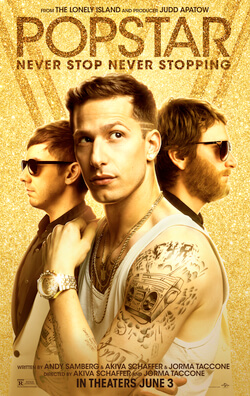
The Lonely Island gang - most notorious for their fake rap SNL Digital Shorts - are back with their first feature film since Hot Rod, the music mockumentary Popstar: Never Stop Never Stopping.
Andy Samberg starts as Connor4Real, a Justin Bieber-ish pop singer who started off as part of a rap group, The Style Boyz (played by fellow Islanders and directors Jorma Taccone and Akiva Schaffer), before going solo and hitting big with his first album, Thriller, Also. Now on the verge of the release of his sophomore joint, Connquest, the documentary is meant to record his triumph, but of course it turns into a Spinal Tapesque debacle. Instead of collaborating with his DJ Owen (Taccone), he's written all the lyrics himself (bad call) and worked with a hundred different producers and the resulting album is both stupid and offensive (in a bad way) and critically savaged.
Popstar's targets - marginally talented pop idols surrounded by yes men, living in a bubble divorced from reality; tabloid journalism as embodied by a running TMZ spoof fronted by Will Arnett, etc. - are easy fish-in-a-barrel stuff, but they managed to hit most of the marks. The music spoofs aren't as good as their SNL-era material, but suffice.
Samberg is OK doing his thing, but the surprise MVP is SNL alum Tim Meadows as Connor's long-suffering manager. Meadows has never really had much of a movie career after SNL - The Ladies Man did about as well as It's Pat and Superstar (i.e. not good) - and he's quite good with the material he has here as a man who used to be part of New Jack Swing-era band Tony! Toni! Toné! as the forth Tony with a question mark: Tony! Toni! Toné! Tony? There is also a parade of real musicians playing along with the gag as well as surprise cameos I won't spoil here.
Sweetly raunchy - it is co-produced by Judd Apatow and if you liked the gratuitous penises in Walk Hard: The Dewey Cox Story you'll be happy here, too - and innocuously amusing, Popstar never real pops hard, but it's worth watching for music spoof and Lonely Island fans.
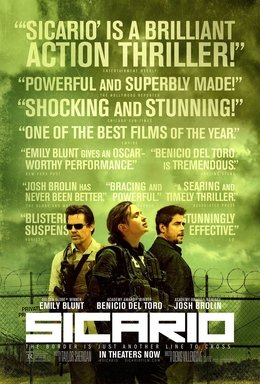
As we're told in an opening title card, Sicario means "hitman" in Mexico. It could also mean (according to me) "somewhat overrated movie."
Emily Blunt stars an FBI agent who as lead of a hostage rescue team leads a raid on a drug den in Arizona and after narrowly escaping death discovers the walls are filled with bodies of victims of the cartels. (While it's a striking image, it doesn't make much sense. Why stash rotting corpses in your walls when there's plenty of desert out the back door to bury them?) Recruited to a join a DEA task force run by Josh Brolin with his mysterious sidekick Benicio del Toro, she rapidly suspects this is a CIA operation (which would be illegal on US soil) and is sucked into the violence of life fighting the brutal cartels.
There was a lot of praise for Sicario upon its release, but I attribute that to director Denis Villeneuve's constant simmering tone of dread. But like his previous film, Prisoners, that dread is in service to a script that is frustratingly thin under the gloom; it's as if playing the scenes slowly - bordering on monotonously - lends the impression of depth where little exists. It's not that the movie isn't great looking - with Roger Deakins' Oscar-nominated cinematography, how couldn't it? - with well-staged scenes and strong performances, it's just not as profound as the tone conveys, a problem with Prisoners as well.
Taylor Sheridan's script fancies itself a meditation on how far should good people go to fight truly evil people, but undermines the complexity by making del Toro's motivations so obvious that their attempts to cloud him with mystery insulting and having Blunt's by-the-book Girl Scout persona undermine her supposed kick-ass chick veneer by having her come off as naive more than idealistic. As she does one dumb thing after another against the advice of people whom she should be listening to, you start to wonder if dumb luck has kept her alive this long. Some struggle with her being seduced by the efficacy of drifting into the gray ethical terrain would've done Sicario a lot of good.
On the AV front, the transfer is nice and sharp with even the darkest scenes clear without banding. (Which is why properly-encoded physical discs will always trump streaming.) I don't have the speakers to judge the Dolby Atmos soundtrack, but on an old 5.1 system the low-end menace of Jóhann Jóhannsson Oscar-nominated score (it was also nommed for Sound Editing) came through to amp Villeneuve's dread.
Extras are thin with a quartet of brief features discussing the look of the film, the stars, the score and the background of the cartel wars which inspired the screenplay. The signature border crossing shootout (it's in the trailer, so no spoiler) required building a replica of that stretch of road because using the actual crossing was impossible, but while we see blue screen walls off in the distance which would be replaced by CGI extensions, they never go into how that was done. There is no commentary, which may've been because Villeneuve is from Quebec and has an accent, but why not have scripter Sheridan talk?
Not as good as the hype and frustrating in it dumb bunny lead, Sicario is one of those movies that make people leery of films with tons or critics' pull quotes on the poster. It's still worth a watch as long as you temper your expectations going in and don't mind being a bit annoyed the next day.
Score: 7/10. Catch it on cable. (It is currently on Amazon Prime.)
If you watch(ed) the movie, check out this analysis of the border crossing scene which also, surprisingly, calls out the Villeneuve's dragging out of things.
This video condenses most of the info bits from the extras in case you watch it on TV instead of renting/buying the BD. BTW, the rental versions don't include extras, only the retail copies.
Rock star memoirs are a dime a dozen, but for some reason Duff McKagen's tome It's So Easy: and other lies got the documentary concert treatment in It's So Easy and Other Lies. (Don't ask me why the capitalization and punctuation.
Part standard documentary with interviews and part concert film as McKagan sits reading excerpts from his book while backed by an band strumming mellow lounge versions of Gun 'n' Roses tunes, It's So Easy (itself a GNR tune title) follows McKagan from his DIY punk roots in Seattle, his exodus from the heroin death zone in 1984 to LA and his meeting up with Slash and company (you'll notice a distinct lack of anything Axl even in band footage), onto his nearly dying from alcohol-induced pancreatitis, sobering up, getting married and starting a family, Velvet Revolver, falling off the wagon, the usual Behind The Music drill.
McKagan's stage readings are stiff compared to his voluble offstage interview persona and I'm not sure what this mixed media presentation provides that a straight documentary couldn't have. It's different, but not necessarily an evolution of the format and frankly, I think the method constrains the story from delving deeper into some parts of his life that would've merited more attention. You'll also notice that while there are several members of GnR interviewed and historical footage, Axl is never shown. Weird.
Since oddternative (I just made that word up!) band OK Go became a viral sensation maker with their video for "Here It Goes Again" (the one where they're on treadmills), they've been in and escalating race to top their previous videos which work the theme of one single shot with wildly complex Rube Goldberg machines or complicated framing and props that are like Michel Gondry on steroids.
Earlier this year, they dropped this eye-popper for "Upside Down & Inside Out":
While they state up front that they shot it in an airplane flying parabolic arcs - the same method for parts of Apollo 13 - the limitation of creating weightlessness this way is that you only get about 27 seconds of zero-G per arc and the song was three-minutes-long.
So how did they do it? That's what the brief (19 mins) documentary Gravity Is Just A Habit (the title is a line from the lyrics) details, showing how the band connected with Russian filmmakers and used a huge cargo plane with the airplane set inside to film this epic in brief chunks, splicing it together to present a seemingly seamless whole.
While it looks like it'd be fun, it was actually grueling, nauseating work that took weeks of flights to pull off. The ending "Thunderdome" segment (where they burst paint balloons) is a point of drama because they'd thought they'd gotten a perfect take only to discover paint had landed on the lens, ruining the end. The debate about whether to take one more flight is complicated by one member, who looks absolutely miserable, not wanting to do it but knowing it has to be done.
If you're a behind-the-scenes junkie, this is well worth the time to check out.
Score: 7/10. Catch it on Netflix.
UPDATE: This video actual does a better job in explaining how they did it in a quarter of the time.
As someone who doesn't really follow tabloid hype stories very closely, the name Amanda Knox meant very little. I was vaguely aware that she was an American exchange student who has gone to Italy and then some girl (her housemate) turned up brutally murdered and there were intimations that Knox and her Italian boyfriend had killed her in some weird sex game gone super wrong. It seemed like I was always hearing her name pop up over and over as she was convicted, had that overturned, then reconvicted in absentia, etc.
Hot off the success of their stunning Making A Murderer documentary series, Netflix is clearly hoping for similar cultural buzz for Amanda Knox, a cursory primer of the case which dragged on eight years from the time of the murder to her final exoneration. With interviews with Knox, her lover, the British reporter leading the yellow journalism charge, and the chief investigator from the town's police, it superficially recaps the investigation and trial and subsequent reversals.
The problem Amanda Knox has is that her case was widely disseminated with every tawdry detail and how the police totally screwed the pooch with their investigation, basically convicting two people with tainted evidence. The shock power of Making A Murderer came from the fact that outside of Wisconsin, no one had really heard of this case and with 10 hours to work with, there was tons of video footage of the trials which laid out the case that some serious miscarrying of justice was going on and no one should be feeling good about how those convictions were secured. Amanda Knox is a brief hour-and-a-half with which to address years of events and there's simply not enough there there.
If you know little about Amanda Knox's excruciatingly slow slog through the Italian justice system, then Amanda Knox is a tidy catcher-upper. Otherwise, there's nothing new other than inconsequential interviews with the players.
While scrolling through Netflix I was surprised to see there was a documentary about NYC-based cartoon-punk band Peelander-Z called Mad Tiger. I'd been seeing them when they came through town for about 15 years and casually followed their career (i.e. went to shows; never bought records), noting when drummer Peelander Blue (they go by color-coded names and outfits) returned to Peelander Planet and was replaced by Peelander Green, etc.
I've photographed their shows several times - you can see those shots here, here and here - and while they always had a theatrical/audience participation element to the band, over the years they tilted heavily into the show and the music itself became almost an afterthought as almost every song would break down into some sort of bit.
The surprising part of Mad Tiger is that it documents their final tour with Peelander Red as he was exiting the band in 2012. My last set of photos were from that tour and I had no idea Red had left. Other revelations were that the girl (Peelander Pink) who'd been around the latter tours as a keyboardist/hype woman/merch girl was Peelander Yellow's wife; that Red worked as a bartender and was quitting to get married himself and open a bar (which apparently happened without him; it's two businesses later according to Google searches and he's not mentioned in any stories); they imported another bassist from Japan (they're all Japanese ex-pats living in NYC) who lasted one show and drummer Peelander Green decided to quit, too.
All well and good, but the fundamental problem with Mad Tiger is that unless you are familiar with the band and its shtick, there is very little to grasp onto. We never see complete songs - merely impressionistic snippets from shows in an attempt to convey chaotic energy - and the way they dole out revelations about their private lives (the Yellow-Pink marriage is like whispering a state secret) and cover the band stifles any narrative flow.
By the end, you will know a few things about some aging Japanese fellows who had a band that eventually disbanded, though that's misleading as YouTube had videos of them playing in the past month with Pink now on bass (though one has another bassist on stage, too). While I learned some things, I didn't learn much more than trivia and those unfamiliar with the band will be perplexed as to why this movie exists.